
exploring task orientation: insights for early childhood leaders

Image by Sandwish from iStock
Is your early care and education program known for its efficiency? Are projects and tasks thoughtfully planned? Would staff describe the program as productive? Is procrastination an exception rather than a rule? Efficiency, planning, and productivity are all qualities that make task orientation a powerful asset. When meetings start and end on time, projects move forward with ease, deadlines are met, and outcomes are achieved, staff tend to experience more satisfaction than when the opposite occurs. Staff perceptions about task orientation shape how they feel about their workplace and influence the organizational climate of the program.
In the book Measuring Work Attitudes in the Early Childhood Setting: Technical Manual for the Early Childhood Job Satisfaction Survey and the Early Childhood Work Environment Survey (3rd ed.), task orientation is defined as “the emphasis placed on organizational effectiveness and efficiency, including productive meetings, program outcomes, and accountability.” If you have a knack for task orientation, you are likely skilled at planning and productivity. People rely on you to move projects forward, and your success rate is high. These are qualities that make task orientation advantageous. The challenge lies in balance: ensuring that efficiency does not come at the expense of dialogue, collaboration, or staff well-being.
Without balance, task orientation can result in ending discussions prematurely, offending people by frequently checking in on them and monitoring their work, pushing people beyond their capacity, and creating an environment marked by anxiety. However, when task orientation is paired with trust and reflection, it strengthens both outcomes and relationships, creating a climate where productivity and trust thrive together.
To understand how task orientation is shaping your leadership, it helps to begin with yourself. As a director, you set the tone for productivity and model how tasks are prioritized and accomplished. Reflecting on your own practices provides a foundation for examining how task orientation is expressed across the program.
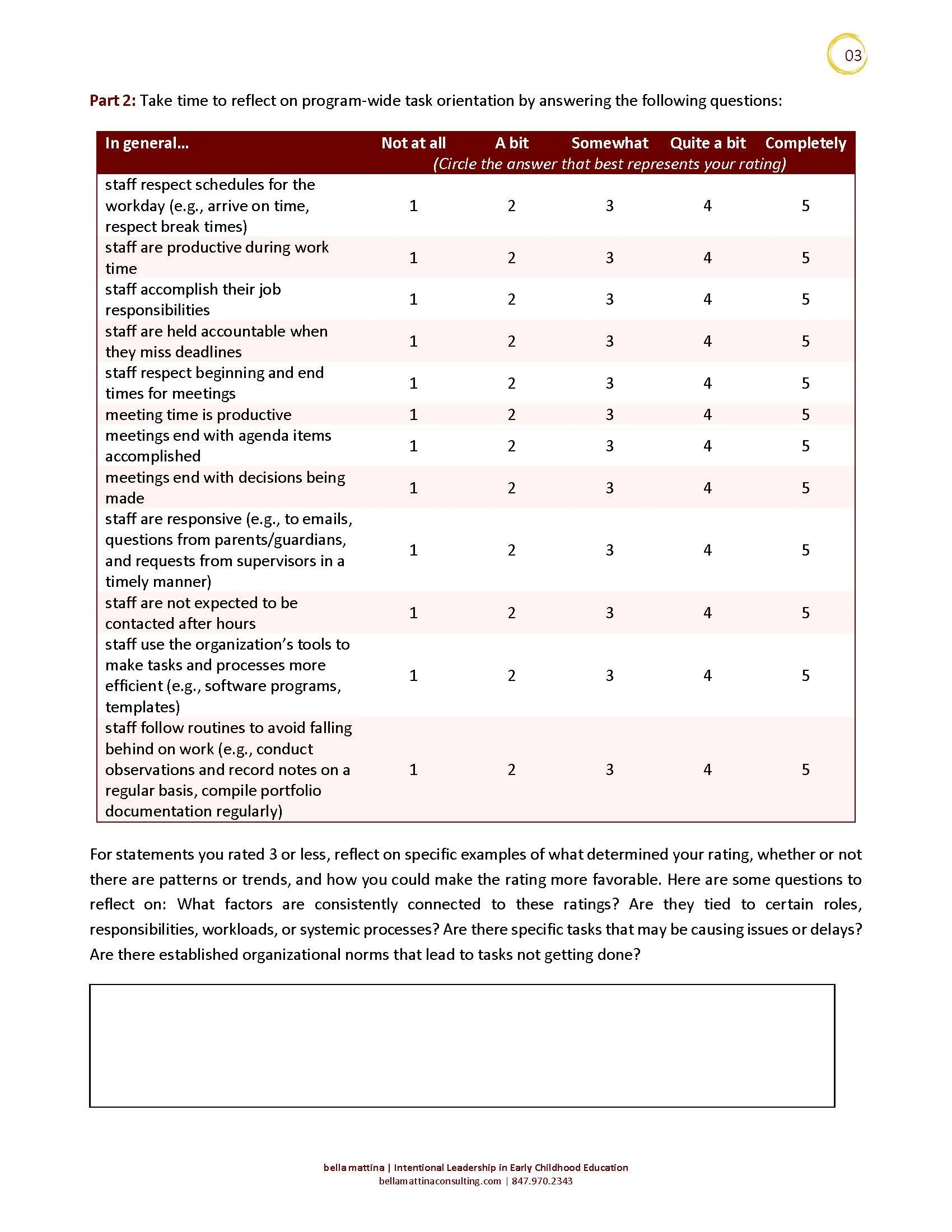
The following questionnaire is designed to guide that reflection. First, explore your personal approach to efficiency and productivity in Part 1. Then, in Part 2, consider how organizational practices support—or challenge—task orientation. Together, these perspectives offer valuable insight into how efficiency and effectiveness are integrated throughout your program.
RESOURCES
Bloom, P. J. (2016). Measuring work attitudes in the early childhood setting: Technical manual for the early childhood job satisfaction survey and the early childhood work environment survey, 3rd ed. Everbloom Learning.
Bloom, P.J., Bella, J.M., & Hentschel, A. (2025). A great place to work: Creating a healthy organizational climate, 3rd ed. Everbloom Learning.


Interested in learning more? Bella Mattina offers leadership training sessions designed for lasting change. Read more about task orientation in A Great Place to Work: Creating a Healthy Organizational Climate, 3rd Edition. The 3rd Edition will be available in December 2025!